Great Expectations
Great Expectations is a masterpiece of Victorian literature that follows Pip's journey from an impoverished orphan to a London gentleman. It's highly rewarding to study because it offers a scathing critique of class and justice, whilst exploring timeless themes of ambition, love, and moral redemption.
Study Notes
Overview
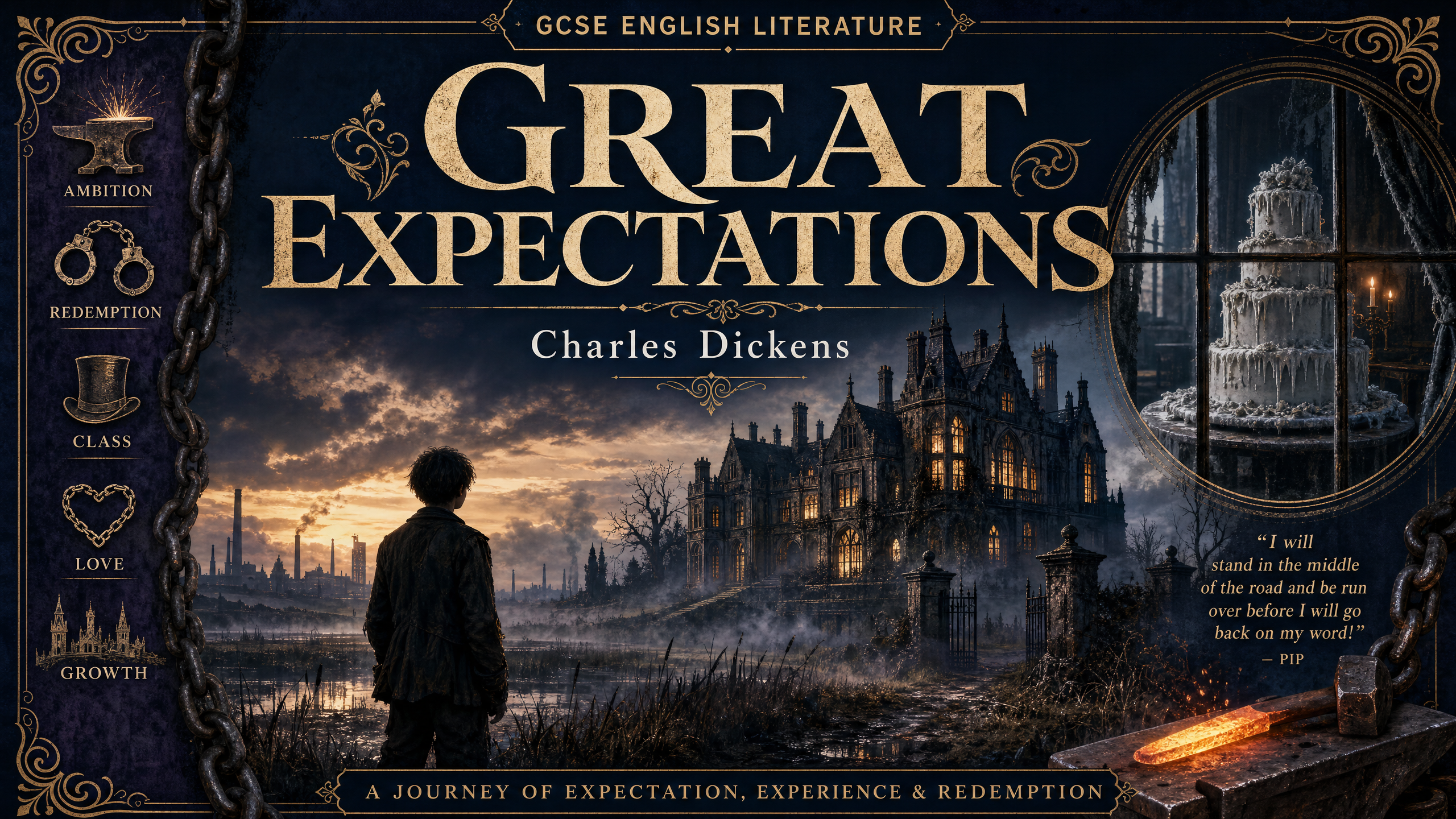
Great Expectations (1861) is a bildungsroman—a coming-of-age novel—that traces the moral and psychological development of its protagonist, Pip. Written by Charles Dickens in his mature period, the novel offers a profound critique of Victorian society, particularly its obsession with wealth, status, and its harsh penal system. Examiners look for candidates who can look beyond the complex plot to analyse how Dickens constructs his narrative. A strong response will explore Dickens's use of the older, retrospective Pip narrating his younger self's mistakes, and how settings like the misty marshes and the decaying Satis House symbolically reflect the characters' internal states and societal corruption.
Plot/Content Overview
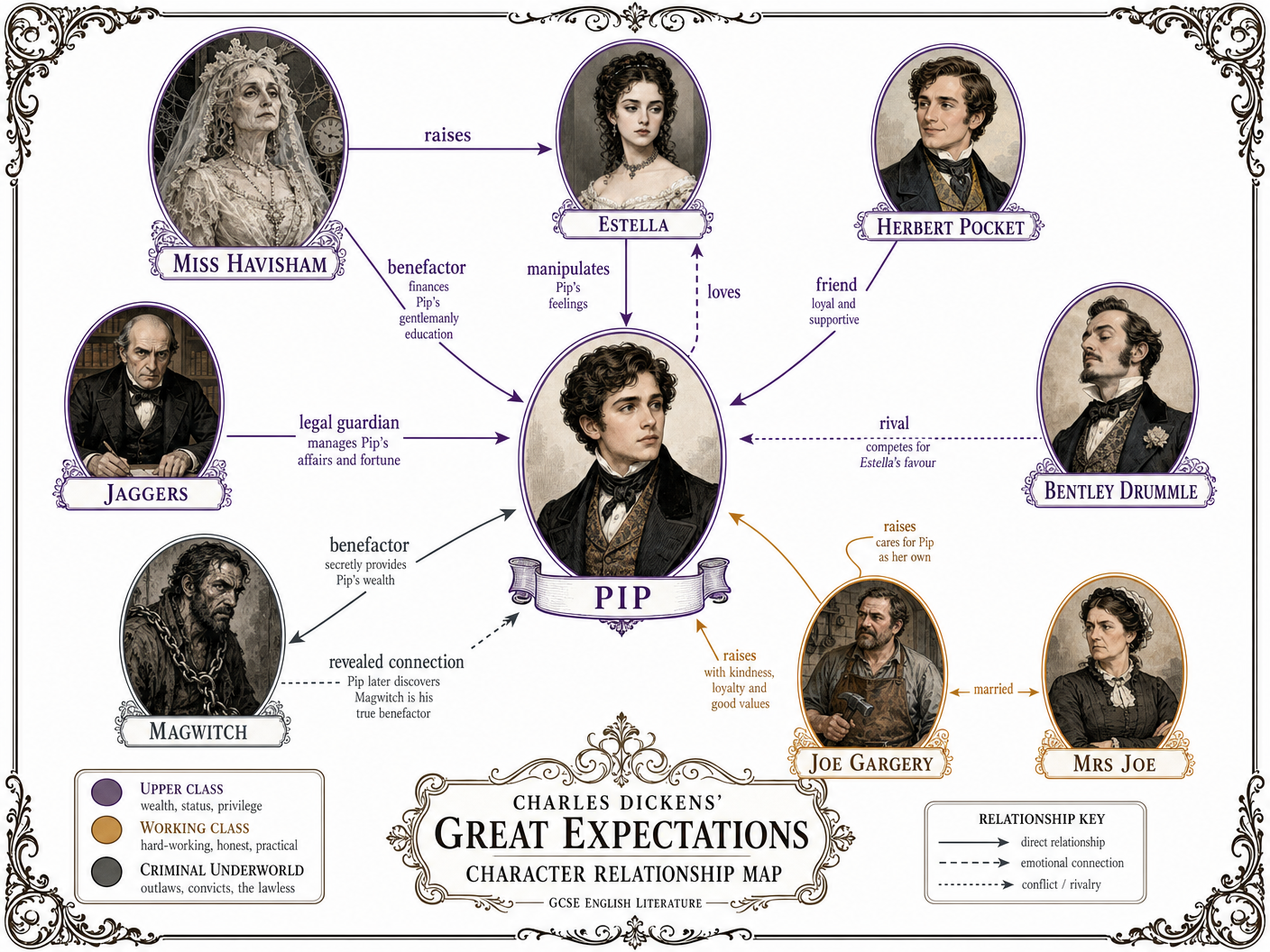
**Volume I (Childhood & The Marshes)**The novel opens on the Kent marshes where a young orphan, Pip, encounters an escaped convict, Magwitch, and steals food for him. Soon after, Pip is invited to Satis House to play for the eccentric, decaying Miss Havisham and her beautiful but cruel adopted daughter, Estella. Pip falls in love with Estella and becomes ashamed of his working-class background. Later, a lawyer named Jaggers informs Pip he has come into "great expectations" from a secret benefactor and must go to London to become a gentleman.
**Volume II (London & The Gentleman)**In London, Pip lives with Herbert Pocket and learns how to be a gentleman, but he becomes snobbish, accumulating debt and treating his loyal brother-in-law, Joe Gargery, with disdain. He believes Miss Havisham is his benefactor and intends for him to marry Estella. The volume ends with a shocking climax: Magwitch, the convict, appears in Pip's rooms and reveals that he is the secret benefactor, having made a fortune in Australia.
**Volume III (Redemption)**Pip's world collapses. He is disgusted by Magwitch but realises he must protect him from the law and his old enemy, Compeyson. Through this ordeal, Pip learns true compassion. Magwitch is captured and dies in prison, forfeiting his fortune to the Crown. Pip falls ill, is tenderly nursed back to health by the forgiving Joe, and finally understands that moral worth is far more important than social class. He goes abroad to work honestly, returning years later to a final, ambiguous meeting with Estella.
Themes
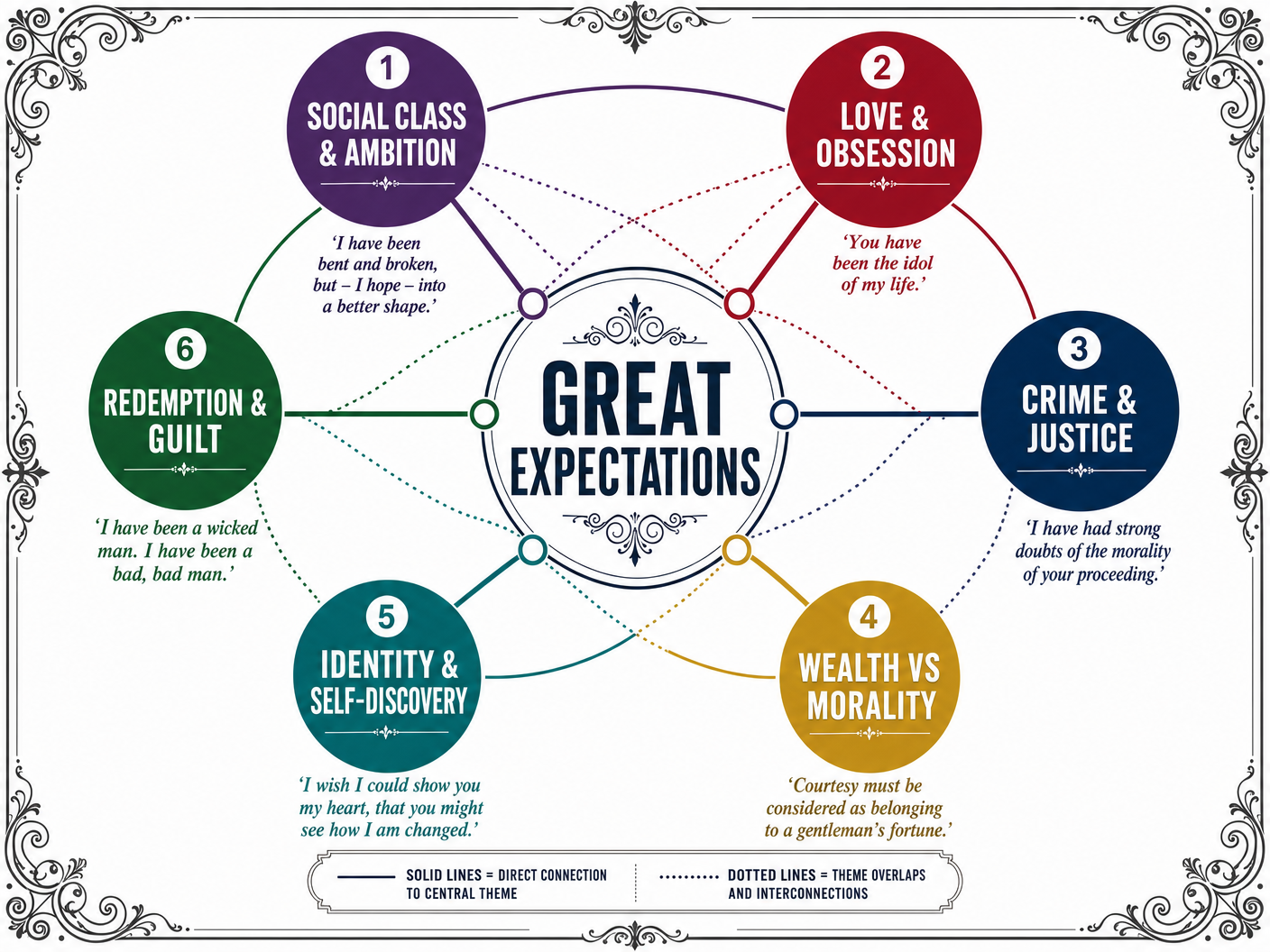
Theme 1: Social Class and Ambition
Dickens heavily critiques the Victorian class system, suggesting that true gentility is a matter of morality, not wealth or birth. Pip's ambition to become a gentleman corrupts him; he distances himself from the honest, working-class Joe in favour of the superficial upper classes.
Key Quotes:
- "I had believed in the best parlour as a most elegant saloon; I had believed in Miss Havisham as the benefactress of my fortunes." (Volume II) - Reveals Pip's self-deception and the false allure of wealth.
- "It is a most miserable thing to feel ashamed of home." (Volume I) - Shows the corrosive effect of class consciousness on Pip's identity.
- "I was too cowardly to do what I knew to be right, as I had been too cowardly to avoid doing what I knew to be wrong." (Volume I) - Highlights how Pip's ambition compromises his moral courage.
Theme 2: Crime, Justice, and the Penal System
Dickens exposes the brutality and hypocrisy of the Victorian justice system. The law punishes the desperate (like Magwitch) severely, while allowing the manipulative and privileged (like Compeyson) to exploit the system.
Key Quotes:
- "In the little world in which children have their existence... there is nothing so finely perceived and so finely felt, as injustice." (Volume I) - Establishes Pip's early, instinctive understanding of fairness, which he later loses.
- "I have been a wicked man. I have been a bad, bad man." (Volume III) - Magwitch's confession, though he is ultimately shown to have a better heart than the "gentlemen" of the novel.
Theme 3: Love, Obsession, and Manipulation
Love in the novel is rarely healthy; it is often obsessive or transactional. Miss Havisham weaponises Estella to exact revenge on men, while Pip's love for Estella is based on idealisation rather than genuine connection.
Key Quotes:
- "I'll tell you what real love is. It is blind devotion, unquestioning self-humiliation, utter submission..." (Volume II) - Miss Havisham's toxic definition of love, born of her own trauma.
- "You have been the idol of my life." (Volume II) - Pip to Estella; the word "idol" suggests worship of a false or unfeeling object.
Character Analysis
Pip (Philip Pirrip)
Role: The protagonist and retrospective narrator.
Key Traits: Ambitious, impressionable, snobbish (in Volume II), ultimately redeemable.
Character Arc: Moves from innocent childhood, through corrupting ambition and snobbery, to eventual moral clarity and redemption. He learns that Joe's simple goodness is worth more than London society.
Essential Quotes:
- "I wish I could show you my heart, that you might see how I am changed."
- "I only saw in him a much better man than I had been to Joe."
Miss Havisham
Role: The wealthy, eccentric spinster who manipulates Pip.
Key Traits: Vengeful, obsessive, decaying, ultimately repentant.
Character Arc: Frozen in time since being jilted at the altar, she raises Estella to break hearts. She eventually realises the horrific damage she has caused to both Estella and Pip, begging for forgiveness before her death.
Essential Quotes:
- "What have I done! What have I done!"
- "I stole her heart away and put ice in its place."
Abel Magwitch
Role: The convict and Pip's secret benefactor.
Key Traits: Fearsome but deeply loyal, generous, victim of the social system.
Character Arc: Introduced as a terrifying monster on the marshes, he is later revealed to be Pip's benefactor. His selfless devotion to Pip contrasts sharply with the selfishness of the upper classes.
Essential Quotes:
- "I'm your second father. You're my son—more to me nor any son."
- "Look'ee here, Pip. I'm your uncle, but I've been a convict."
Joe Gargery
Role: Pip's brother-in-law and surrogate father.
Key Traits: Uneducated, deeply moral, loyal, forgiving.
Character Arc: Joe remains constant throughout the novel. He is the moral compass against which Pip's behaviour is measured and found wanting.
Essential Quotes:
- "Ever the best of friends; ain't us, Pip?"
- "Life is made of ever so many partings welded together..."
Writer's Methods
Dickens uses several key techniques that you must analyse to secure AO2 marks:
- Retrospective First-Person Narrative: The older, wiser Pip narrates the story, allowing Dickens to present the younger Pip's foolishness while the older narrator judges it. Look for moments of dramatic irony where the narrator knows more than the character.
- Setting and Atmosphere (Pathetic Fallacy): Settings reflect character and theme. The misty marshes represent confusion and danger; Satis House (meaning "Enough House") is ironic, as it is a place of decay, darkness, and starvation, reflecting Miss Havisham's internal state.
- Caricature and Satire: Dickens exaggerates characters' physical traits to reflect their moral nature (e.g., Jaggers's obsessive hand-washing, Mrs Joe's aggressive apron). This satirises Victorian institutions and social climbing.
- Structure: The three-volume structure perfectly mirrors the three stages of Pip's bildungsroman: innocence, corruption, and redemption.
Context
To hit AO3, integrate these contextual factors into your analysis:
- The Victorian Class System: A rigid hierarchy where movement was difficult. Dickens critiques the idea that wealth equals morality.
- The Industrial Revolution: Created new wealth (like Pip's "expectations") but also extreme poverty and social anxiety.
- The Penal System: Punishments were severe, and transportation to Australia was common. Dickens highlights the injustice of a system that punishes the poor disproportionately.
- Dickens's Own Life: His father was imprisoned for debt, forcing a young Charles to work in a blacking factory. This trauma fuelled his lifelong sympathy for the poor and his hatred of social injustice.
Podcast Revision
Listen to our 10-minute revision podcast covering the core themes, character arcs, and exam tips:
Visual Resources
2 diagrams and illustrations
Interactive Diagrams
1 interactive diagram to visualise key concepts
Conceptual Flow Outline
Pip's Bildungsroman Arc across the Three Volumes
Worked Examples
2 detailed examples with solutions and examiner commentary
Practice Questions
Test your understanding — click to reveal model answers
Explore how Dickens presents the importance of forgiveness in Great Expectations. (30 marks)
Hint: Consider Joe's forgiveness of Pip, Pip's forgiveness of Miss Havisham, and Pip's eventual acceptance of Magwitch.
Starting with the extract where Magwitch reveals himself as Pip's benefactor, explore how Dickens presents criminals and the justice system. (30 marks)
Hint: Look at the language Pip uses to describe Magwitch in the extract, then compare Magwitch's crimes to Compeyson's in the wider novel.
Explore how Dickens presents the relationship between Pip and Estella. (30 marks)
Hint: Remember that their relationship is engineered by Miss Havisham. How does Pip's view of Estella change by the end of the novel?
How does Dickens use settings to reflect the themes of the novel? (30 marks)
Hint: You must discuss the Marshes, Satis House, and London. Use the term 'pathetic fallacy'.